

Carnac Prehistory Museum – 450,000 Years of Human History
The Carnac Museum of Prehistory, the world's first museum devoted entirely to megalithic culture (founded in 1882), exhibits more than 3,000 archaeological artifacts representing 450,000 years of human history. Exceptional collections from the European Neolithic period: burial sites, dolmens, variscite (Spanish jewelry), Alpine jade axes, engraved cave art. Chronological Paleolithic-Gallo-Roman exhibition on two floors, interactive area for young visitors, creative workshops, guided tours, models of megaliths. Municipal facility listed as a Historic Monument since 1928. Located 500-700m from Les Druides campground in downtown Carnac, it is a world-renowned archaeological site that provides context for your visit to the alignments and 3,000 menhirs, the largest preserved megalithic complex in Europe.
📌 About This Museum
Camping Les Druides recommends visiting the museum via its blog and recommendation articles.
Important: The Museum of Prehistory is a municipal public facility managed directly by the City of Carnac. Les Druides campground:
does not organize visits
does not make reservations
does not manage admission fees
We highly recommend this exceptional museum to enrich your stay.
For information on updated 2026 opening hours and prices, please contact the Museum of Prehistory directly using the contact details at the end of this article.

🏛️ History & Prestige of the Museum (1882-2026)
Pioneer Foundation – World Archaeology
First museum entirely dedicated to megalithism:
1873 - Arrival of Scotsman James Miln:
Founder: James Miln (1819–1881), a passionate Scottish gentleman
Motivation: Attracted by the worldwide fame of the Carnac megaliths
Excavations: From 1873 to 1881 on the Kermario Alignments, Saint-Michel tumulus, regional dolmens
Discoveries: Massive collections of prehistoric artifacts
1882 - Opening of the Miln Museum:
Legacy: Bequest of the James Miln collection to the municipality of Carnac
Construction: Robert Miln (James's brother) has a special building constructed at his own expense.
Inauguration: J. Miln Museum – the world's first museum dedicated exclusively to megalithic culture
A world first: never before has a museum been dedicated solely to this subject.
1928 - Listed as a Historic Monument:
Curator: Zacharie Le Rouzic (local resident, student of James Miln)
Enrichments: Ongoing regional excavations, expanded collections
Decision: All collections classified as Historic Monuments
National recognition: Major archaeological heritage site
1984 - New Modern Building:
Former rectory converted into a prehistory museum
Location: 10 Place Chapelle, Carnac town center
Accessibility: Close to megalithic alignments and sites
Inauguration: 1985 by Minister of Culture Jack Lang
2026 - Permanent Global Reference:
Recognition: World-renowned archaeological institution
Influence: Pioneer of all European megalithic museums
New building: Work in 2025 to extend Rue Poul Person (3,200 m² over 3 floors)
Context Carnac – European Megalithic Gem
Carnac: a globally unique archaeological site:
🗿 Carnac Alignments: ~3,000 menhirs, the largest megalithic site in Europe still standing
🗿 Dolmens & Tumuli: Impressive Neolithic collective burial sites
🗿 Center of Power: Great European wealth at the beginning of the 5th millennium BC
🗿 Long-distance trade: Variscite from Spain, jade from the Alps passing through Carnac
The museum: essential context: Prepare for your visit to the alignment sites with in-depth archaeological insight.
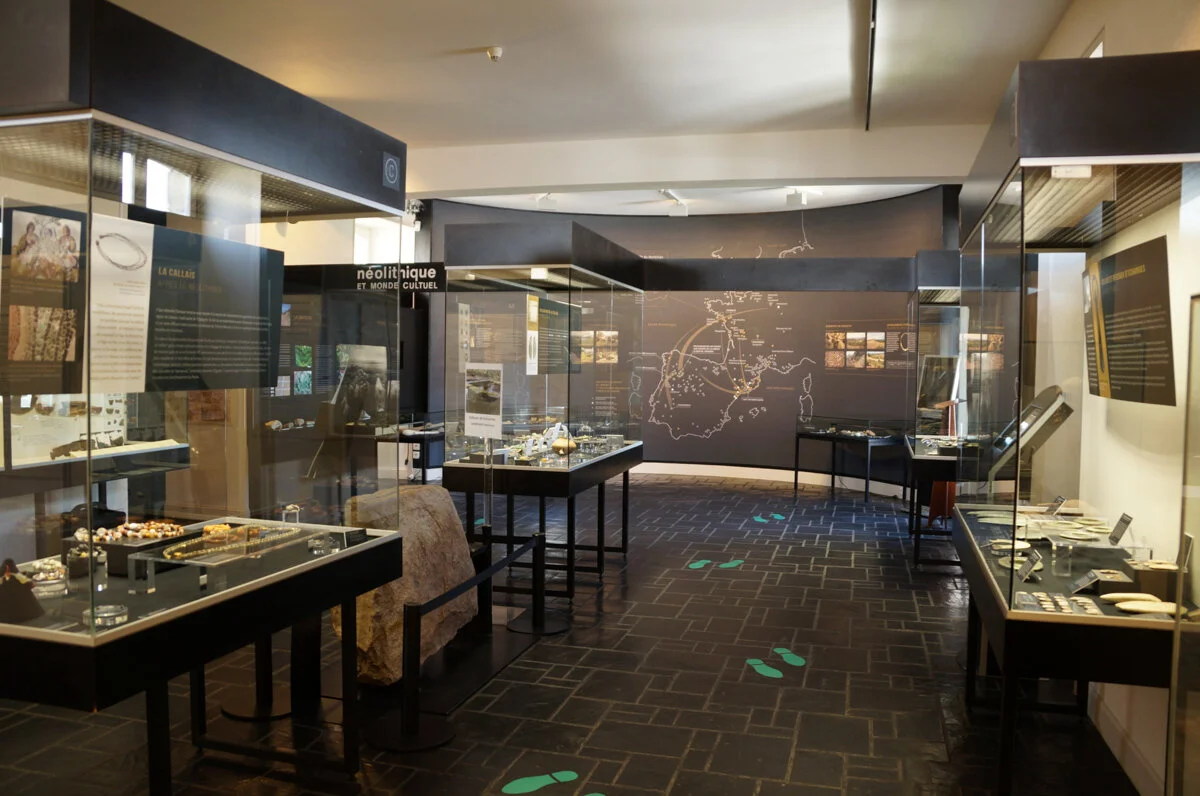
📂 Exceptional Collections (Over 3,000 Artifacts on Display)
General Wealth
One of the richest collections of prehistory in Europe:
Number of objects: 3,000+ archaeological artifacts on display (350,000 in storage)
Historical richness: 450,000 years of human history represented
Provenance: Excavations at Carnac sites and distant trading regions
Layout: Two floors, chronological and thematic itinerary
Presentation formats:
Themed displays organized by period
Architectural models and megalithic reconstructions
Castings of engraved slabs – parietal art dolmens
Archaeological maps and plans geographical context
Bilingual French-English informational texts
Interactive touch screens for young audiences
📚 Historical Periods on Display
Paleolithic (450,000–11,000 years BP)
Origins: first human settlements in Brittany:
Timeline:
450,000 years BP: Pointe Saint-Colomban site (Homo erectus)
400,000 years BP: Menez-Dregan dwellings – complex dwellings
Species: Homo erectus roamed the beaches and cliffs of Brittany.
Artifacts:
Stone tools: Bifaces, scrapers, cores
Traces of fire: Organized settlements
Faunal remains: Bones of hunted animals
Mesolithic (11,000–6,000 years BP)
Transition from hunter-gatherers:
Innovations:
Microliths: Small blades used to arm arrows
Fishing gear: Hooks, harpoons, nets
Coastal sites: Shell middens as evidence of food sources
Neolithic period (6,000–2,200 years BP) – CORE COLLECTIONS
The height of Carnac megalithism:
Megaliths:
Dolmen burials: Monumental collective tombs, engraved slabs
Standing menhirs: Mysterious alignments of raised stones
Tumulus: Burial mounds containing rich grave goods
Cave art: Engravings – geometric and anthropomorphic symbols
Exceptional funeral furnishings:
Green variscite: Beads and jewelry imported from Spain (evidence of long-distance trade)
Alpine jade axes: Prestigious tools imported from the Italian Alps
Ceramics: Decorated pottery, carinated vases
Jewelry: Necklaces, bracelets, shell pendants
Flint blades: Carved tools from Le Grand-Pressigny (Touraine)
Historical significance: Carnac was a center of Neolithic power in Europe, with a trade network extending to Spain and the Alps.
Bronze Age (2,200–800 years BP)
Copper and bronze metallurgy:
Artifacts:
Socket axes: Specialized copper/bronze tools
Tool deposits: Monetary economic groupings
Metal jewelry: Twisted bracelets, pins, brooches
Gold jewelry: Necklaces, bracelets of prestigious elites
Evolution: Stone-to-bronze transition, emergence of hierarchical society.
Iron Age (800 BC - 58 BC)
Iron metallurgy - first layers:
Discoveries:
Currencies: Commercial exchange coins
Amphorae: Containers for Mediterranean wines
Glass objects: Innovative luxury accessories
Iron tools: Sickles, picks – advanced technology
Salt furnaces: Reconstruction of coastal economic activity
Context: Complex Hallstatt society, Celtic influences.
Gallo-Roman period (58 BC - 500 AD)
Gallic acculturation & Roman fusion:
Major exhibitions:
Villa Bosséno: Large, affluent rural residence
Mosaics: Geometric figurative pavements
Thermal baths: Hypocaust heating system sophisticated installations
Sigillata ceramics: Fine pottery imported from Gaul
Roman coins: Denarii, Antoninianus coins attesting to trade
Glass: Luxury containers, glazing
Statuettes: Syncretic deity figurines
Meaning: Gradual integration into the Roman world.

🎯 Interactive Space for Young Audiences
Child-friendly educational area dedicated to children:
Interactive Discovery
Touchscreens: Digital guided tour by theme
Educational games: Archaeology quiz, object identification
Educational videos: Reconstructions of prehistoric life
Permanent Creative Workshops
Freehand drawing: Personal sketches of megaliths
Wood construction: Miniature architecture, menhirs, dolmens
Clay modeling: Creating Neolithic pottery
Documentation
Comic books: Illustrated stories for young readers
Specialized journals: Children's archaeology magazines
Giant illustrated books: Explicit picture albums
Audience: Children of all ages accompanied by adults.
🎓 Guided Tours with Commentary
Standard Guided Tour
Full exploration format:
Duration: 1.5 to 2.5 hours depending on pace and interest
Format: Individuals, small groups, families
Guide: Professional archaeologist or accredited guide
Contents: Complete chronology Paleolithic-Gallo-Roman
Language: French (English upon request)
Strengths:
Context including megaliths and alignments
Detailed excavation reports
Direct Q&A with experts
"À Petits Pas" Tour for Children (4+)
Specifically for young families:
Audience: Ages 4 and up with parental guidance
Duration: approximately 1 hour and 15 minutes, at a pace suitable for children
Hours: Saturdays during school holidays 10:15 a.m .
Format: Illustrated story, playful objects
Contents:
Prehistoric adventures for children
Objects that can be observed up close
Interactive quiz games
📋 Practical Information 2026
Location & Access
Location in central Carnac:
📍 Address: 10 Place Chapelle, 56340 Carnac
📍 Distance from Les Druides Campground: 2 km
📍 Access: Town center, clearly marked
📍 Parking: Chapelle & Saint-Fiacre public parking lots nearby
2026 timetable
Hours outside of school holidays:
January-February: Closed for the entire period
March-April-November: 2:00 p.m. to 5:30 p.m. (closed on Tuesdays)
May-June-July-September: 10 a.m.-12:30 p.m. / 2 p.m.-6 p.m. (closed on Tuesdays)
August: 10 a.m. to 6:30 p.m. (open daily)
October: 10 a.m.–12:30 p.m. / 2 p.m.–5:30 p.m. (closed on Tuesdays)
December: Completely closed
Special closures: January 1, May 1, December 25.
School Holiday Schedule 2026
Open every day during all vacation periods:
January-February-March: 10 a.m.-12:30 p.m. / 2 p.m.-5:30 p.m.
April–May: 10 a.m.–12:30 p.m. / 2 p.m.–6 p.m.
July-August: 10 a.m.-6:30 p.m. (continuous)
October-November-December: 10 a.m.-12:30 p.m. / 2 p.m.-5:30 p.m.
Admission Prices
Indicative prices – Check with the museum for updates in 2026:
Full price for adults: ~€7
Children (6-17 years old): ~€3
Children (under 6 years old): Free
Reduced rate: ~€5 (Megalith Pass, CNAS, students)
Children's workshops: €5–12 (school holidays)
Guided tour: Special pricing (check with the museum)
Payment methods: Cash, credit cards, checks, ANCV vacation vouchers.
Accessibility for people with reduced mobility
♿ Accessible museum:
Barrier-free entrance: Easy access for people with reduced mobility
Elevator: Full navigation on two levels
Adapted toilets: Accessibility standards
Disabled parking: Reserved spaces nearby
Specific information: Contact the museum directly.
Museum Shop
Specialized tourism trade:
📚 Archaeology books: Popular science essays
📚 Reproductions of artifacts: Variscite jewelry, replica axes
📚 Educational guides: Workbooks for children and adults
📚 Postcards: Images of megalith collections
📚 Minerals: Variscite samples, fossils
Recommended Visit Duration
⏱️ Depending on exploration depth:
Quick tour: 1–1.5 hours overview of main collections
Full tour: 2–2.5 hours reading panel texts
In-depth exploration: 3+ hours of careful study of display cases
With workshop: 2.5-3 hours museum + 1-hour workshop
🏕️ From Les Druides Campground
Very close access to the museum:
✅ Distance: 2 km on foot
✅ Walk: 20 minutes at a leisurely pace to the town center
✅ Archaeological site: Heart of the Carnac megalithic zone
✅ Maison Mégalithes: 1.5 km maximum (national monuments)
Additional camping services:
Heated pool: Relaxation after your visit
Bar Carpe Diem: Drink break before going out
Tourist Office brochures: Complete documentation on megaliths
Ideal itinerary: Morning museum → Lunch at the campground → Swimming pool → Afternoon alignments! 🗿
✨ In Summary
The Carnac Museum of Prehistory, the world's leading museum of megalithic culture (1882), offers an exceptional journey through 450,000 years of human history. Exceptional collections of over 3,000 artifacts: burial sites, dolmens, engraved cave art, Spanish variscite, Alpine jade, and prestigious ceramics.
Chronological exhibition covering the Paleolithic and Gallo-Roman periods, contextualizingEurope's largest preservedmegalithic site (3,000 menhirs). Interactive space for young visitors, creative workshops, expert guided tours, fully accessible to people with reduced mobility.
From Camping Les Druides, 2 km away, discover this world-renowned archaeological site listed as a Historic Monument (1928). A must-see museum for gaining an in-depth understanding of Neolithic civilizations in Brittany before visiting the alignments.
📞 Contacts
Carnac Museum of Prehistory
Address: 10 Place Chapelle, 56340 Carnac
Telephone: +33 (0)2 97 52 22 04
Website: www.museedecarnac.com
Services:
Guided tours with commentary
Creative workshops for children
Specialized archaeology shop
Full accessibility for people with reduced mobility
Timetables & Fares: Check the website for updates 2026
Carnac Tourist Office
Phone: 02 97 52 13 52
Website: www.ot-carnac.fr
Services: Museum information, alignments, archaeological tours
House of Megaliths (National Monuments Center)
Address: Rue Ménec, 56340 Carnac
Website: www.menhirs-carnac.fr
Services: Guided tours of the alignments, exhibitions
Les Druides Campground
Address: 55 Chemin de Beaumer, 56340 Carnac
Telephone: +33 (0)2 97 52 08 18
Website: www.camping-les-druides.com
Distance: 2 km walking museum
Services: Heated swimming pool, Le Carpe Diem bar, tourist information