

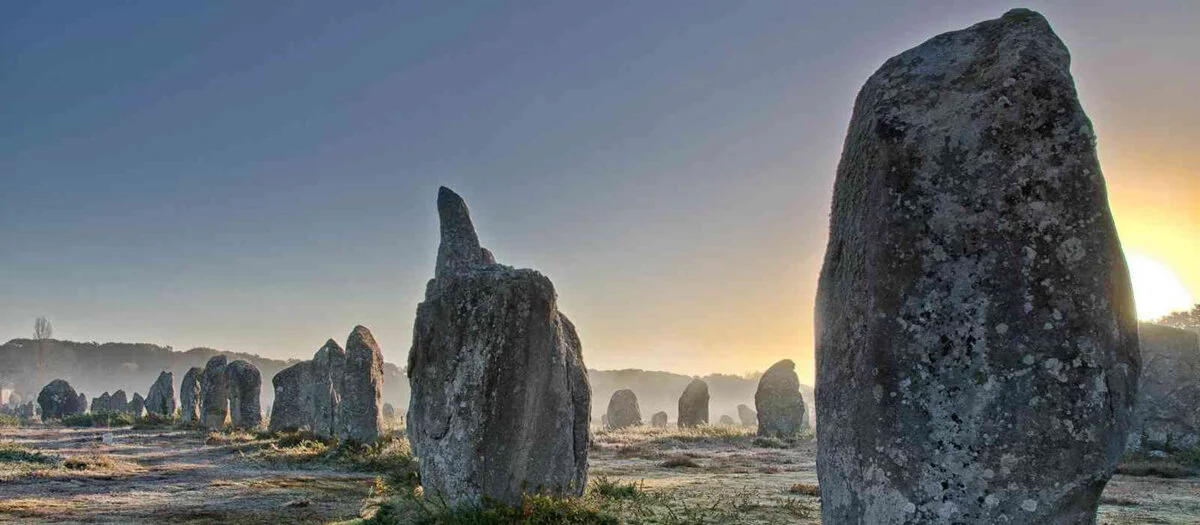
The Carnac Alignments are the largest megalithic site in continental Europe: more than 3,000 menhirs raised 6,500 to 7,000 years ago over 4 kilometres, three main groups (Ménec, Kermario, Kerlescan) and a UNESCO World Heritage listing confirmed on 12 July 2025. This exceptional prehistoric monument, just 3–4 km from Camping Les Druides, offers a fascinating journey into Neolithic civilisation and its enduring mysteries.
📌 About this visit
Camping Les Druides recommends the Carnac Alignments through its blog and its recommendation articles.
Important: the Carnac Alignments and access to them are organised and managed directly by the Maison des Mégalithes, a public body and heritage centre. Camping Les Druides:
-
does not handle bookings;
-
does not offer guided tours;
-
does not organise activities on the site.
We simply recommend this exceptional heritage site to enrich your stay.
For bookings, up-to-date opening times and current prices, contact the Maison des Mégalithes directly using the details at the end of this article.
Enigmatic prehistoric origins
The timeline established by archaeologists
-
6,500 to 7,000 years ago: main construction of the megalithic complex;
-
5th to 3rd millennium BC: intensive building phase (the peak);
-
2,000 BC: gradual reuse and transformation.
Total construction time: more than 1,500 years of successive building, involving entire generations of Neolithic builders within a highly structured social organisation.
The three great alignments
1. The Ménec alignment – the most monumental group
The most representative group on the Carnac site:
Current dimensions:
-
1,050 menhirs currently visible;
-
950 metres long;
-
100 metres wide;
-
11 almost perfectly parallel rows;
-
Height: from 4 metres in the west down to 0.6 metres in the east (gradual decrease);
-
Terminal cromlech: 71 blocks forming a circle at the western end.
Architectural features:
-
the stones get gradually smaller the further they are from the centre;
-
remarkable geometric parallelism despite Neolithic means;
-
deliberate architecture that follows the lie of the land.
Access:
-
October to March: free unaccompanied visit (outside school holidays);
-
April to September: guided tours with access inside the enclosure;
-
Maison des Mégalithes: information point 150 m away (permanent exhibition, shop, panoramic café);
-
Free car park: easy parking on the western side.
2. The Kermario alignment – mass and power
The second major group on the site:
Dimensions:
-
1,029 menhirs in a massive configuration;
-
1,200 metres long;
-
100 metres wide;
-
10 almost parallel rows;
-
Imposing stones of thick, robust local granite.
Panoramic viewpoint:
-
The old Kermaux mill: a metal staircase gives a view from above;
-
Photographic perspective: a view over 1,000+ menhirs from the top;
-
Bird's-eye view: the layout of the alignments becomes clearly visible.
Access: free walking trails, free car park on the eastern side.
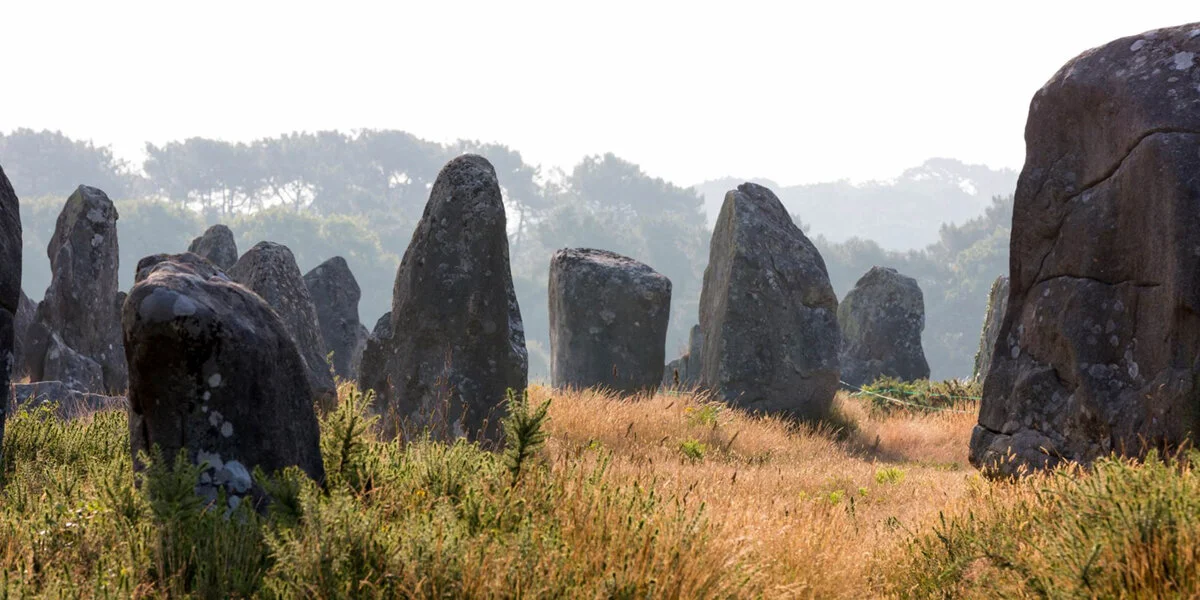
3. The Kerlescan alignment – preserved and discreet
The best preserved and least visited group:
Features:
-
555 menhirs preserved (originally around 540 to 600);
-
13 rows of menhirs (the best preserved on the site);
-
Quadrangular enclosure: 39 blocks set almost edge to edge;
-
Natural setting: stones surrounded by protective woodland;
-
Exceptional preservation: less disturbed by historic quarrying.
The Giant of Manio:
-
6.5 metres tall: the tallest menhir in Carnac;
-
Located to the north of the Manio alignment;
-
A majestic presence dominating the woodland views.
Access: less visited, peaceful atmosphere, dedicated walking trails.
Neolithic megalithic architecture
General structure of the complex
Component elements:
-
Aligned menhirs: monolithic standing stones set in organised rows;
-
Circular enclosures: cromlechs closing off the alignments;
-
Tumuli: prestige burial mounds (the Saint-Michel tumulus: 125 m × 65 m × 12 m high);
-
Dolmens: gallery graves and collective burial chambers.
Integration into the landscape:
-
monumental stones on the high points;
-
smaller stones in the valleys;
-
visual continuity between monuments;
-
an overall design that incorporates the topography.
4. The Saint-Michel tumulus in Carnac
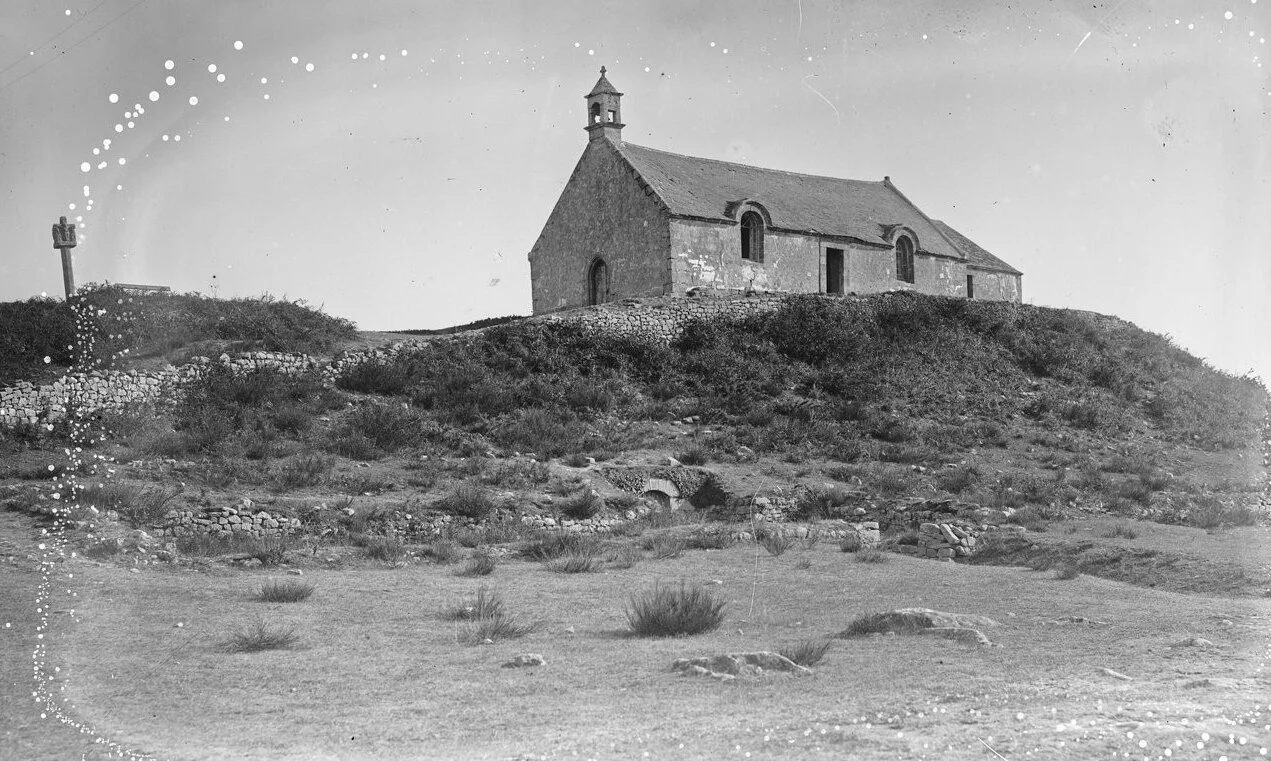
Nearly 35,000 m3 of carefully arranged material, laid down from the beginning of the 5th millennium BC, make up the artificial hill crowned by a chapel dedicated to the archangel Saint Michael.
This monumental funerary architecture, built for a leading figure of the time, spectacularly embodies remarkable technical skill, an exceptionally determined group of builders and, above all, a social hierarchy attested by the quality of the grave goods found inside.
The Saint-Michel tumulus, excavated by archaeologists in the second half of the 19th century and at the turn of the 20th century, is indeed a burial of gigantic dimensions, originally intended for a single person and containing a set of prestige objects. The raw materials of these objects (Italian jadeite, for example) and the fineness of their polishing testify to the particularly high social rank of the deceased.
The choice of location plays a full part in the exceptional character of the burial: the highest point in the area. Visible to everyone from everywhere, the monument, restored by the Centre des monuments nationaux, rewards those who reach the top with a unique panorama.
Around ten monuments in the vicinity of the alignments are less well known and sometimes hard to reach, but some deserve to be brought to the attention of the public, such as the Moustoir and Crucuny tumuli.
Raw material and construction techniques
Monolithic granite:
-
Local Morbihan quarries: the source of supply;
-
Single blocks: each menhir is a separate monolith;
-
Impressive weight: some stones exceed 250 tonnes.
Probable techniques:
-
plant-fibre ropes for hauling and transport;
-
wooden logs as levers and force systems;
-
earth ramps for gradual rolling;
-
pits to stabilise and anchor the bases.
Workforce: hundreds of people over several centuries, with a highly structured social organisation.
Mysteries and scientific hypotheses
Enduring archaeological enigmas
1. A religious and sacred function:
-
places of worship and ritual ceremonies;
-
tribute to natural forces (sun, moon, cosmic phenomena);
-
association with the dolmens and burial tumuli.
2. An astronomical observatory:
-
alignments oriented towards solstices and equinoxes;
-
calendar markers for Neolithic farming;
-
sophisticated astronomical calculations.
3. Territorial markers:
-
marking out tribal boundaries;
-
assertion of power and community prestige;
-
monuments for social gatherings.
4. Processional ways:
-
ritual routes between sacred sites;
-
funeral processions towards the tumuli;
-
ceremonial roads for major events.
Scientific consensus: probably a combination of several functions (religious, astronomical, social) that evolved over the centuries.
UNESCO World Heritage listing 2025
Historic recognition confirmed
-
Official date: 12 July 2025 (47th session of the World Heritage Committee);
-
Scope: the Carnac megaliths and the shores of the Morbihan (550+ monuments);
-
UNESCO criteria: exceptional testimony to a vanished civilisation, a megalithic complex unique in the world;
-
Implications: stronger protection, greater tourist appeal, international reach.
The first Breton site on the World Heritage List, on a par with Stonehenge (United Kingdom) and the Pyramids of Giza (Egypt).
Visiting the alignments
Maison des Mégalithes – the main visitor centre
Services and facilities:
Permanent exhibition:
-
educational videos reconstructing Neolithic life;
-
information panels on timelines and hypotheses;
-
scale models of the monuments.
Visitor services:
-
ticket office for guided tours;
-
free documentation (brochures, maps, guides);
-
practical information (opening times, accessibility, weather);
-
specialist shop (archaeology and science books).
Panoramic terrace:
-
180° view over the Ménec alignment;
-
café serving drinks and refreshments.
Location: Avenue du Ménec, opposite the site, 150 m from the main entrance.
Guided tours and activities
Expert guided tours:
-
Duration: 1 h 30 to 2 h with an archaeologist or specialist guide;
-
Themes: history, architecture, mysteries, Neolithic life;
-
Languages: French, English, German (depending on the season);
-
Booking: recommended in high season.
Tourist train:
-
commented circuit of the three main alignments;
-
duration: around 40 minutes;
-
suitable for families with young children.
Educational workshops:
-
interactive discovery of the site;
-
activities for children and adults;
-
booking recommended.
For up-to-date opening times, check directly with the Maison des Mégalithes or the Carnac tourist office.
Practical information
Location and access
Addresses of the three sites:
-
📍 Ménec: Avenue du Ménec, 56340 Carnac
-
📍 Kermario: Route de Kermario, 56340 Carnac
-
📍 Kerlescan: Chemin de Kerlescan, 56340 Carnac
Distance from Camping Les Druides: 3–4 km on foot to Ménec.
Free car parks: spacious bays at Ménec for motorhomes, and at Kermario for cars only.
Opening times and accessibility
Unaccompanied visit (free):
-
October to March: permanent outdoor access without booking;
-
April to September: free access to the perimeter paths.
Guided tours (paid):
-
October to March: on request, booking in advance;
-
April to September: daily, at regular times;
-
July and August: extended programme in high season.
Accessibility for reduced mobility:
-
disabled parking at Ménec;
-
Maison des Mégalithes accessible (lift);
-
easy access to the panoramic terrace;
-
guided tours can be adapted on request;
-
Limitation: uneven natural terrain (unsurfaced paths).
Recommended time
⏱️ Depending on how deeply you want to explore:
-
Quick visit: 1 h 30 to 2 h (general overview);
-
Standard visit: 2 h 30 to 3 h 30 (full circuits);
-
In-depth exploration: 4 h+ (the complete walk);
-
With the Museum of Prehistory: a full day is recommended.
From Camping Les Druides
Exceptionally close to a World Heritage site
Camping Les Druides gives you ultra-close access to the Carnac Alignments:
-
✅ 4 km on foot to the Ménec site;
-
✅ 30 minutes of easy walking to the megaliths;
-
✅ In the heart of the archaeological zone (alignments, dolmens and tumuli nearby);
-
✅ Maison des Mégalithes 150 m from the Ménec alignments for full information.
Campsite services:
-
heated pool (to relax after your archaeological walk);
-
Le Carpe Diem bar (outdoor aperitif possible);
-
tourist office documentation at reception (maps, guides).
The ideal day: morning at the megaliths → lunch at the campsite → pool → Museum of Prehistory in the late afternoon! 🗿
Why visit the Carnac Alignments?
The Carnac Alignments offer an archaeological experience unique in Europe: 3,000 menhirs, silent witnesses to a sophisticated Neolithic civilisation dating back 6,500 to 7,000 years. Between enduring mysteries, monumental architecture and the 2025 UNESCO listing, this heritage site is a fascinating journey into European prehistory.
From Camping Les Druides, just a few kilometres away, discover this archaeological jewel where 7,000 years of human history remain engraved in 3,000 granite monoliths.
📞 Information and contacts
Maison des Mégalithes Carnac
Address: Avenue du Ménec, 56340 Carnac
Telephone: +33 2 97 52 29 81
Website: www.menhirs-carnac.fr
Email: contact@menhirs-carnac.fr
Opening: all year round (exhibition, ticket office, information)
Carnac tourist office
Address: 74 avenue des Druides, 56340 Carnac
Telephone: +33 2 97 52 13 52
Website: www.ot-carnac.fr
Camping Les Druides
Address: 55 Chemin de Beaumer, 56340 Carnac
Telephone: +33 2 97 52 08 18
Website: www.camping-les-druides.com/en