

Carnac Alignments – 3,000 Menhirs and Neolithic Mystery
The Carnac Alignments are the largest megalithic site in continental Europe: more than 3,000 menhirs erected 6,500 to 7,000 years ago over 4 kilometers, three main groups (Ménec, Kermario, Kerlescan), and a UNESCO World Heritage listing confirmed on July 12, 2025. This exceptional prehistoric monument, located just 3 km from Les Druides Campground, offers a fascinating insight into Neolithic civilization and its enduring mysteries.

📌 About This Tour
Camping Les Druides recommends the Carnac Alignments via its blog and recommendation articles.
Important: The Carnac Alignments and access to them are organized and managed directly by the Maison des Mégalithes, a public institution and heritage center. Les Druides campground:
does not handle reservations
does not offer guided tours
does not organize activities on the site
We highly recommend this exceptional heritage site to enrich your stay.
For all booking requests, updated opening hours, and 2026 prices, please contact the Maison des Mégalithes directly using the contact details at the end of this article.
Enigmatic Prehistoric Origins
Chronology Established by Archaeologists
6,500 to 7,000 BC: Main construction of the megalithic complex
5th to 3rd millennium BC: Intensive construction phase (heyday)
2000 BC: Gradual reuse and transformation
Total construction time: Over 1,500 years of successive building, mobilizing entire generations of Neolithic builders in a highly structured social organization.
The Three Great Alignments
1. Alignment of the Menhirs – The Most Monumental Ensemble
The most representative ensemble at the Carnac site:
Current dimensions:
1,050 standing stones currently visible
950 meters in length
100 meters wide
11 nearly perfect parallel rows
Height: From 4 meters in the west to 0.6 meters in the east (gradual decrease)
Terminal cromlech: 71 blocks forming a circle to the west
Architectural features:
Gradual decrease in stone size as they move away from the center
Remarkable geometric parallelism despite Neolithic means
Intentional architecture following the topography
Accessibility:
October–March: Free admission (except during school holidays)
April–September: Guided tours with interior access
Maison des Mégalithes: Information point 150m away (permanent exhibition, shop, panoramic café)
Free parking: Easy parking on the west side
2. Kermario's Alignment – Massiveness and Power
Second major feature of the site:
Dimensions:
1,029 menhirs in a massive configuration
1,200 meters in length
100 meters wide
10 nearly parallel rows
Imposing stones made of thick, sturdy local granite
Panoramic observation point:
Old Kermaux Mill: Metal staircase offering a view from above
Photographic perspective: View of over 1,000 menhirs from the elevation
Aerial view: The organization of the alignments becomes clearly visible.
Access: Free walking trails, free parking on the east side.
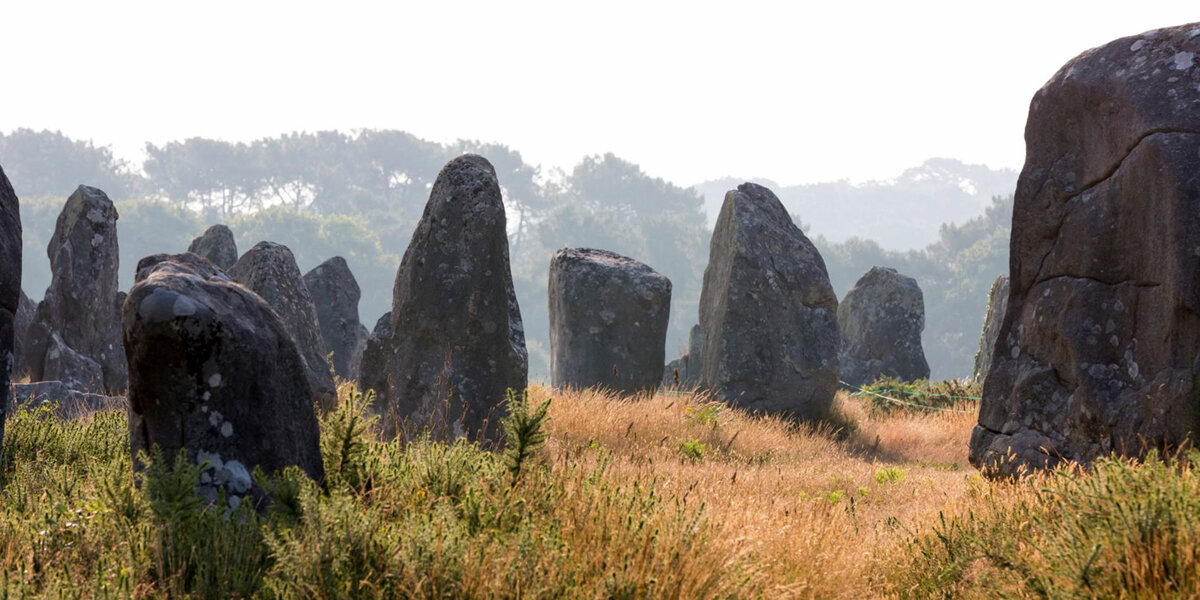
3. Kerlescan Alignment – Preservation and Discretion
The most preserved and least visited area:
Features:
555 standing stones preserved (originally ~540-600)
13 rows of menhirs (the best preserved on the site)
Quadrangular enclosure: 39 blocks almost joined together
Natural setting: Stones surrounded by protective forest
Exceptional preservation: Less disturbed by historical quarries
The Giant of Manio:
6.5 meters high: The tallest menhir in Carnac
Located north of the Manio alignment
Majestic presence dominating the forest views
Accessibility: Less crowded, peaceful atmosphere, dedicated hiking trails.
Neolithic Megalithic Architecture
General Structure of the Complex
Constituent elements:
Aligned menhirs: Monolithic stones standing in organized rows
Circular enclosures: Cromlechs closing the alignments
Burial mounds: Prestigious burial sites (Saint-Michel burial mound: 125 m × 65 m × 12 m high)
Dolmens: Covered galleries and collective burial chambers
Topographic integration:
Monumental stones on high points
Smaller stones in the valleys
Visual continuity between monuments
Overall diagram incorporating topography
4. The Saint Michel burial mound in Carnac
Nearly 35,000 m3 of materials, skillfully arranged since the beginning of the 5th millennium BCE, form the artificial hill on which stands a chapel dedicated to the archangel Saint Michael.
This monumental funerary architecture, intended for a prominent figure of the time, spectacularly embodies remarkable technical skills, the builders' particularly accomplished motivation, and above all, a social hierarchy attested to by the quality of the furnishings found inside.
Indeed, the Saint-Michel burial mound, excavated by archaeologists in the second half of the 19th century and at the turn of the 20th century, corresponds well to a burial site of gigantic dimensions originally intended for a single person and containing a collection of prestigious objects. The raw materials used to make these objects (Italian jadeite, for example), combined with the fineness of the polishing, attest to the particularly high social status of the deceased.
The choice of location for the tomb contributes greatly to its exceptional nature: the highest point in the area. Visible to all from everywhere, the monument, restored by the Centre des Monuments Nationaux, offers a unique panorama once you reach the summit.
A dozen or so monuments surrounding the alignments are less well known and sometimes difficult to access, but some are worthy of public attention, such as the Tumulus du Moustoir and Tumulus de Crucuny.

Raw Materials and Construction Techniques
Monolithic granite:
Local quarries in Morbihan: Source of supply
Unique blocks: Each menhir is a separate monolith.
Impressive weight: Some stones weigh over 250 tons.
Likely techniques:
Plant fibers for drainage and transport
Log levers and force systems
Ground ramps for gradual rolling
Ditches for stabilization and anchoring of bases
Mobilization: Hundreds of men over several centuries, highly structured social organization.
Mysteries and Scientific Hypotheses
Persistent Archaeological Mysteries
1. Religious and sacred function:
Places of worship and ritual ceremonies
Homage to natural forces (sun, moon, cosmic phenomena)
Association with dolmens and burial mounds
2. Astronomical observatory:
Alignments oriented toward solstices and equinoxes
Calendar markers for Neolithic agriculture
Sophisticated astronomical calculations
3. Territorial markers:
Delimitation of tribal boundaries
Assertion of power and community prestige
Monuments of social gathering
4. Processional routes:
Ritual journeys between sacred sites
Funeral processions to burial mounds
Ceremonial routes for major events
Scientific consensus: Probably a combination of several functions (religious, astronomical, social) evolving over the centuries.
UNESCO World Heritage Listing 2025
Confirmed Historical Recognition
Official date: July 12, 2025 (47th session of the World Heritage Committee)
Perimeter: Carnac Megaliths and Morbihan Coast (550+ monuments)
UNESCO criteria: Exceptional testimony to a vanished civilization, a megalithic complex unique in the world
Implications: Enhanced protection, increased tourism promotion, international influence
The first site in Brittany to be listed as a World Heritage Site, alongside Stonehenge (United Kingdom) and the Pyramids of Giza (Egypt).
Visit to the Alignments
House of Megaliths – Main Visitor Center
Services and facilities:
Permanent exhibition:
Educational videos recreating Neolithic life
Informative panels on timelines and hypotheses
Scale models of monuments
Tourist services:
Ticket office for guided tours
Free documentation (brochures, maps, guides)
Practical information (opening hours, accessibility, weather)
Specialty store (books on archaeology and science)
Panoramic terrace:
180° view of the Ménec alignment
Coffee with beverages and refreshments
Location: Avenue du Ménec, opposite the site, 150m from the main entrance.
Guided Tours and Activities
Expert guided tours:
Duration: 1.5 to 2 hours with an archaeologist or specialized guide
Themes: History, architecture, mysteries, Neolithic life
Languages: French, English, German (depending on the season)
Reservations: Recommended during peak season
Tourist train:
Guided tour of the three main alignments
Duration: ~40 minutes
Suitable for families with young children
Educational workshops:
Interactive discovery of the site
Activities for children and adults
Reservations recommended
For updated 2026 opening hours, please contact the Maison des Mégalithes orthe Carnac Tourist Office directly.
Practical Information
Location and Access
Addresses of the three sites:
📍 Ménec: Avenue du Ménec, 56340 Carnac
📍 Kermario: Route de Kermario, 56340 Carnac
📍 Kerlescan: Chemin de Kerlescan, 56340 Carnac
Distance from Camping Les Druides: 3 km on foot to Le Ménec
Free parking: Spacious parking spaces at Le Ménec for motorhomes and Kermario, cars only.
Hours and Accessibility
Self-guided tour (free):
October–March: Permanent outdoor access without reservation
April–September: Free access to peripheral trails
Guided tours (fee required):
October–March: Upon request, advance booking required
April–September: Daily, regular schedule
July-August: Enhanced programming during peak season
Accessibility for people with reduced mobility:
Disabled parking at Ménec
Maison des Mégalithes accessible (elevator)
Panoramic terrace with easy access
Guided tours can be customized upon request
Limitation: Rough natural terrain (unpaved roads)
Recommended Duration
⏱️ Depending on exploration level:
Quick tour: 1.5-2 hours (general overview)
Standard tour: 2.5–3.5 hours (complete tours)
In-depth exploration: 4 hours+ (full hike)
With the Museum of Prehistory: Full day recommended
From Les Druides Campground
Exceptional proximity to World Heritage sites
Camping Les Druides offers extremely close access to the Carnac Alignments:
✅ 4 km walk to the Ménec site
✅ 30 minutes' leisurely walk to the megaliths
✅ In the heart of the archaeological zone (alignments, dolmens, adjacent tumuli)
✅ Maison des Mégalithes (House of Megaliths) 150 m from the Ménec alignments for comprehensive information
Campground services:
Heated swimming pool (relaxation after an archaeological hike)
Bar Carpe Diem (outdoor aperitif available)
Tourist Office documentation available at reception (maps, guides)
Ideal itinerary: Morning at the megaliths → Lunch at the campground → Swimming pool → Prehistory Museum in the late afternoon! 🗿
Why Visit the Carnac Alignments?
The Carnac Alignments offer a unique archaeological experience in Europe: 3,000 standing stones, silent witnesses to a sophisticated Neolithic civilization dating back 6,500 to 7,000 years. With its enduring mysteries, monumental architecture, and UNESCO 2025 inscription, this heritage site offers a fascinating insight into European prehistory.
Just a few miles from Camping Les Druides, discover this archaeological gem where 7,000 years of human history remain engraved in 3,000 granite monoliths.
📞 Information and Contacts
House of Megaliths Carnac
Address: Avenue du Ménec, 56340 Carnac
Telephone: +33 (0)2 97 52 29 81
Website: www.menhirs-carnac.fr
Email: contact@menhirs-carnac.fr
Opening hours: All year round (exhibition, ticket office, information)
Carnac Tourist Office
Address: 74 avenue des Druides, 56340 Carnac
Telephone: +33 (0) 2 97 52 13 52
Website: www.ot-carnac.fr
Les Druides Campground
Address: 55 Chemin de Beaumer, 56340 Carnac
Telephone: +33 (0) 2 97 52 08 18
Website: www.camping-les-druides.com