

The Megaliths of Carnac, listed as a UNESCO World Heritage Site
Historic recognition for Brittany
On July 12, 2025, the Megaliths of Carnac and the Morbihan Coast were officially inscribed on the UNESCO World Heritage List. This international recognition, which had been awaited for nearly 30 years, celebrates 6,500 years of history and an exceptional collection of more than 550 megalithic monuments comprising nearly 12, 000 stones, including around 3,000 menhirs in the famous alignments of Carnac.
It is the first site in Brittany to be listed as a World Heritage Site and the 54th French site to receive this prestigious distinction.
Registration confirmed on July 12, 2025
At the 47th session of the World Heritage Committee held in Paris, UNESCO experts approved the inscription of the Megaliths of Carnac and the Morbihan Coast, recognizing their outstanding universal value.
The figures behind this recognition
54th French site listed as World Heritage
First Breton site in UNESCO history
Largest megalithic complex in Europe recognized at this level
More than 550 internationally protected megalithic sites
Nearly 12,000 stones across the entire UNESCO site
Approximately 3,000 standing stones in the Carnac alignments
27 municipalities in Morbihan affected by the perimeter
More than 1,000 km² of territory included in the UNESCO site
6,500 years of history since the Neolithic period
Composition of the UNESCO property
The listed property covers a vast area stretching from Quiberon Bay to the Gulf of Morbihan. It includes more than 550 megalithic monuments (alignments, tumuli, dolmens, cairns, steles) spread across four main areas, each surrounded by buffer zones designed to preserve the landscape.

The four areas of concentration
1. Carnac area
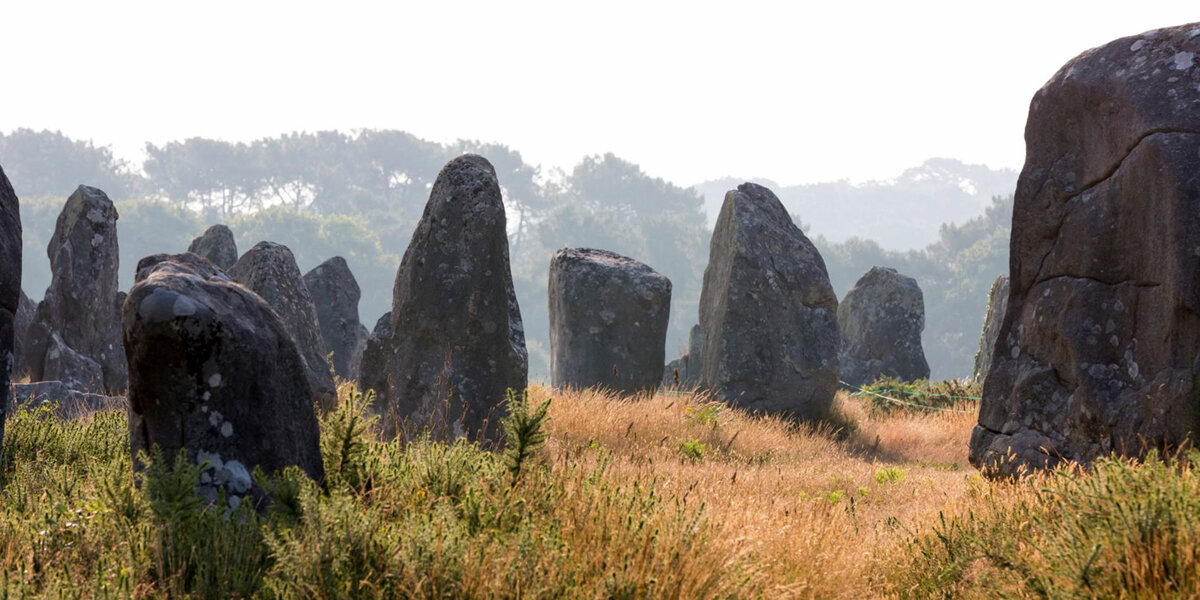
Includes the most famous alignments: Le Ménec, Kermario, and Kerlescan, which alone comprise around 3,000 aligned menhirs. These alignments are icons of the world's megalithic heritage.
2. Vannes area
Includes several alignments and dolmens in the Vannes region, demonstrating the continuity of Neolithic occupation.
3. Locmariaquer area
Home to the Cairn de Gavrinis, famous for its exceptional prehistoric engravings, as well as other major monuments.
4. Auray area
Brings together peripheral megaliths that complete the monumental ensemble and illustrate the geographical extent of this Neolithic civilization.
Outstanding Universal Value
The inscription is based on five major characteristics that define the site's outstanding universal value.
1. Extraordinary density and diversity
More than 550 megalithic monuments comprising nearly 12, 000 stones concentrated in a relatively small area constitute a density that is unique in the world. The Carnac alignments alone comprise around 3,000 menhirs, an absolute record. Nowhere else can so many alignments, tumuli, dolmens, and engraved steles be found gathered in one place.
2. Age and monumental proportions
Built between 4500 and 3300 BC, these monuments bear witness to 1,200 years of architectural activity. Some burial mounds reach gigantic proportions unmatched anywhere else in Europe. These structures are among the oldest monumental organizations in the world.
3. Uniqueness of engravings
The Cairn of Gavrinis and other sites feature spiral engravings, geometric patterns, and enigmatic symbols that constitute a unique form of prehistoric cave art. These remarkably delicate decorations still raise many scientific questions.
4. Exceptional archaeological wealth
The excavations have unearthed objects made of Alpine jade, Baltic amber, and other precious materials from distant regions. These discoveries bear witness tointernational trade and active commercial networks dating back to the Neolithic period, more than 6,000 years ago.
5. Unique megalithic landscape
The intimate link between the coastline, natural landscapes, and megalithic monuments forms a harmonious whole consciously shaped by Neolithic populations. This environmental integration is unparalleled anywhere else in the world.
Twenty-nine years of efforts
World Heritage inscription cannot be improvised. The project required nearly three decades of collective work, scientific research, and collaboration between institutions.
Key steps in the process
1996: The Carnac alignments are added to the French tentative list.
2012–2013: Creation ofthe Association Paysages de Mégalithes (Megalithic Landscapes Association) to support the application.
2017: Drafting of the Statement of Outstanding Universal Value (OUV) and international comparative analysis.
2020: Completion of a comprehensive landscape assessment and signing of a partnership charter.
2021: Validation of the final perimeter by the Ministry of Culture.
Early 2024: Submission of the application file to UNESCO.
Spring 2024 – July 2025: International assessment conducted by UNESCO experts.
July 12, 2025: Official inscription on the World Heritage List.
The players behind the success
The Megalithic Landscapes Association
Founded in 2013, the association brought together 27 municipalities, two public establishments for intermunicipal cooperation (EPCI), the Department of Morbihan, the State, and numerous public and private partners.
President: Olivier Lepick, Mayor of Carnac.
Honorary President: Jean-Yves Le Drian, former Minister of Defense and leading Breton political figure.
Scientific Committee: 18 renowned French and European archaeologists.
Key partners
National Monuments Center (CMN)
Coastal Conservation Agency
Brittany region
Local heritage associations
Committed residents and researchers
Jean-Yves Le Drian, affectionately nicknamed "Le Menhir" (the Menhir) due to his strong regional roots, made an impassioned plea during the UNESCO session in May 2025, thereby contributing to the success of the bid.
The impacts of enrollment
Enhanced protection
World Heritage status requires a specific management plan, periodic monitoring by UNESCO, and a long-term commitment to the conservation of the sites. This international framework guarantees the preservation of heritage for future generations.
Global recognition
The inscription confers considerable international visibility. Every year, tens of millions of people consult the World Heritage List. Carnac thus joins prestigious sites such as Stonehenge and the Egyptian monuments.
Economic and tourism development
Tourist appeal is expected to increase significantly, with positive repercussions for the local economy: accommodation, restaurants, cultural activities, jobs in the heritage sector, and related services.
Scientific research and education
UNESCO recognition encourages international scientific collaboration, promotes educational programs, and enhances access to documentary and archaeological resources for researchers around the world.
New projects and developments
The future Carnac Museum
The town of Carnac has begun construction on a new-generation museum, destined to become a European benchmark for prehistory and megalithic monuments.
Project characteristics:
Location near the current museum
Construction began in 2025
Integration of active scientific research
Innovative museum technologies (augmented reality, interactive devices)
Enhanced accessibility for all audiences
This new facility will enable the archaeological treasures to be displayed in modern conditions, worthy of their UNESCO status.
Improvement of access infrastructure
Road improvement works, particularly on the RD 196 and access roads to the main sites (Le Ménec, Kermario, Kerlescan), are underway to facilitate visitor access while preserving the environment.
Reinforced parking lots
Improved accessibility for people with reduced mobility
Updated signage
Practical information for visitors
Access and prices
House of Megaliths: Free admission all year round.
Free access to alignments: Free from October to March.
Guided tours: Around €13 in high season (July–August), with audio guides available.
New museum: Under construction, opening soon.
The sites therefore remain accessible to all, in line with UNESCO's desire to promote the discovery of world heritage.
Testimonials and reactions
Jean-Yves Le Drian, Honorary President of the Association Paysages de Mégalithes:
"It is a legendary heritage site. I know this well, as I am from the area. This symbol of Brittany inspires mystery and silence. It is supported by a very detailed dossier."
Olivier Lepick, Mayor of Carnac and President of the Association:
"All of the region's partners are proud to have contributed to this global recognition. Extremely proud!"
Ministry of Culture:
"International recognition of the historical, cultural, and scientific value of this exceptional archaeological site."
Frequently Asked Questions
What does this mean for visitors?
Access remains unchanged: free admission to the Maison des Mégalithes, free access to the stone alignments from October to March, and guided tours available for a fee during the summer. The new museum will enrich the cultural offering.
Are the alignments still free to visit?
Yes, free access is maintained during the low season. Guided tours are still subject to a fee during the high season to ensure the quality of the visitor experience and the preservation of the sites.
How many menhirs are there in Carnac exactly?
There are around 3,000 menhirs in the Carnac alignments. The entire UNESCO site comprises more than 550 megalithic sites with a total of nearly 12,000 stones (menhirs, dolmens, tumuli, cairns).
What is the real benefit of inscription?
Enhanced international protection, global scientific recognition, cultural prestige, qualified tourist appeal, local economic development, and international scientific collaborations.
Why did it take 29 years?
UNESCO is very selective: around 50 new sites are added to the list each year worldwide. The procedure requires rigorous scientific documentation, proof of outstanding universal value, international expertise, and a final vote.
Is Carnac becoming too touristy?
UNESCO has imposed a management plan that strictly regulates tourism development. The priority remains preservation and the quality of the visitor experience.
Discover the Megaliths from Les Druides Campground
Camping Les Druides is located just 3 kilometers from the main alignments of Carnac.
Easy access:
By car: 5 minutes
By bike: 15 minutes
Near the campground:
House of Megaliths (free admission)
Alignments of Ménec, Kermario, and Kerlescan (approximately 3,000 menhirs)
Carnac Museum of Prehistory
New museum (under construction)
Take advantage of your stay at the campsite to discover this unique world heritage site, now recognized by UNESCO as one of humanity's treasures. With more than 550 megalithic monuments comprising nearly 12, 000 stones, including the famous 3,000 menhirs of the Carnac alignments, you will explore the largest megalithic complex in Europe.
Useful resources and contacts
Association Paysages de Mégalithes (Megalithic Landscapes Association): www.megalithes-morbihan.fr
House of Megaliths: www.menhirs-carnac.fr | Tel.: +33 (0)2 97 52 89 99
UNESCO – World Heritage List: whc.unesco.org
Carnac Tourist Office: www.ot-carnac.fr
Les Druides Campground: www.camping-les-druides.com | Tel.: +33 (0)2 97 52 08 18
In summary
July 12, 2025 will remain a historic date for Carnac, Brittany, and France. After 29 years of efforts, the Megaliths of Carnac and the Morbihan Coast have been added to the prestigious UNESCO World Heritage List, recognizing 6,500 years of history and an exceptional collection of more than 550 megalithic monuments comprising nearly 12,000 stones, including around 3,000 menhirs in the famous Carnac alignments.
This international recognition reflects the collective commitment of a region that is proud of its heritage and determined to preserve it for future generations. It also paves the way for new cultural and scientific projects, while enhancing the region's appeal.
Come and discover this exceptional heritage during your stay at Camping Les Druides: the world awaits you in Carnac.